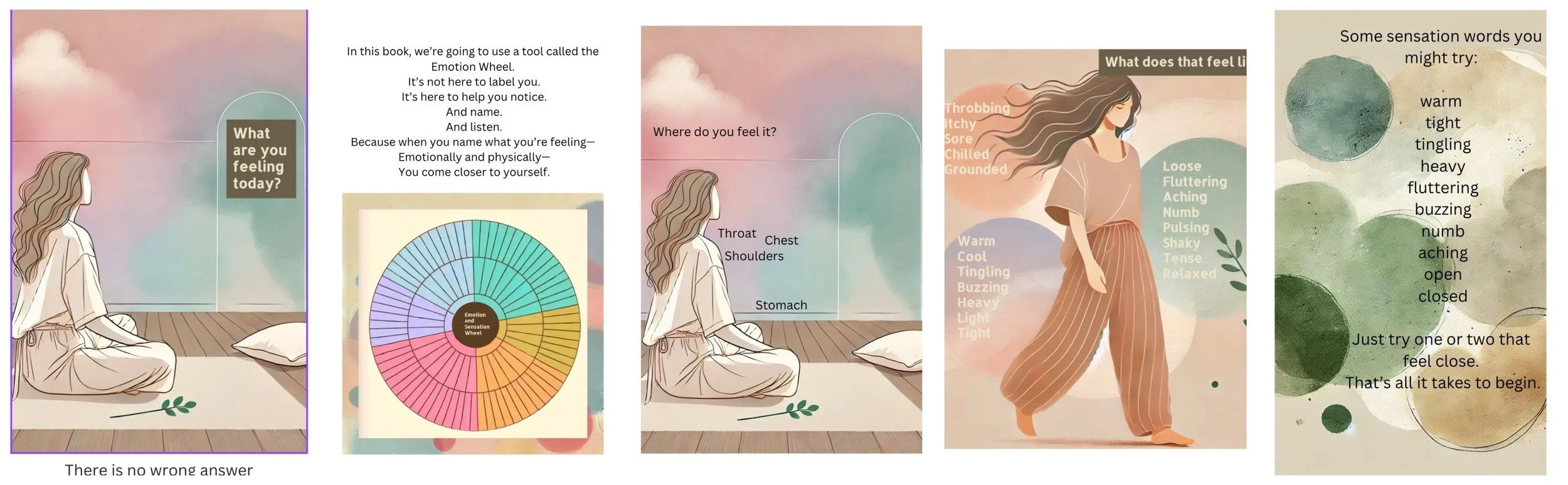
A Visual Guide to Emotional Awareness and Somatic Healing Practices
You Can Spend a Lifetime Living Without Knowing What You Feel.
And still be a remarkably capable human being.
You can raise children, build a career, sustain friendships, care for aging parents, show up at church, make dinner, remember birthdays, and carry out the thousand responsibilities that make up an ordinary life.
You can do all of this while remaining surprisingly unfamiliar with what is happening inside you.
Someone asks how you are.
"Fine," you say.
And perhaps you are.
But perhaps you are disappointed. Or frightened. Or lonely in a way you have not quite admitted to yourself. Perhaps you are deeply content, but have been moving so quickly that you have scarcely noticed.
Perhaps there is a heaviness in your chest, a restlessness in your hands, or a tightening in your stomach that arrives long before you can explain why.
We become proficient at managing the outward demands of life while knowing remarkably little about our inward experiences.
And then we wonder why we react in ways we do not understand.
Why we are irritable when we are actually grieving.
Why a small disappointment can undo an otherwise ordinary afternoon.
Why we struggle to communicate a need we have never learned to recognize.
Or why, even when something wonderful is happening, we find ourselves scarcely able to enjoy it.
A life can be extraordinarily full and still be insufficiently inhabited.
I am interested in what happens when we begin to change that.
The Language We Were Never Given
For years, my work in somatic practice and spiritual formation has brought me into conversations about the relationship between our bodies, our emotions, and the ways we participate in everyday life.
I have become increasingly aware of how much we ask of people who have never been given the vocabulary to describe what they experience.
We tell children to use their words.
We encourage adults to communicate more effectively.
We ask people to manage their emotions, regulate their responses, and make wise decisions.
But what happens when the words themselves are missing?
Some of us grew up in homes where anger was dangerous, sadness was inconvenient, or fear was something to conceal.
Others learned to explain their emotions rather than recognize them. We became exceptionally good at giving reasonable accounts of why we ought to be fine.
And some of us were simply never invited to pay much attention.
We learned what to do.
We learned how to behave.
We did not necessarily learn how to notice what was happening within us.
This is one of the reasons I created Feel It. Name It. Come Back.
It is a visual, practical guide to emotional awareness and somatic practices, designed to help people recognize feelings, develop a richer emotional vocabulary, and become more attentive to the physical sensations that accompany everyday experience.
It is not a book about becoming preoccupied with ourselves.
It is about becoming better able to participate in our own lives.
What Are You Feeling Today?
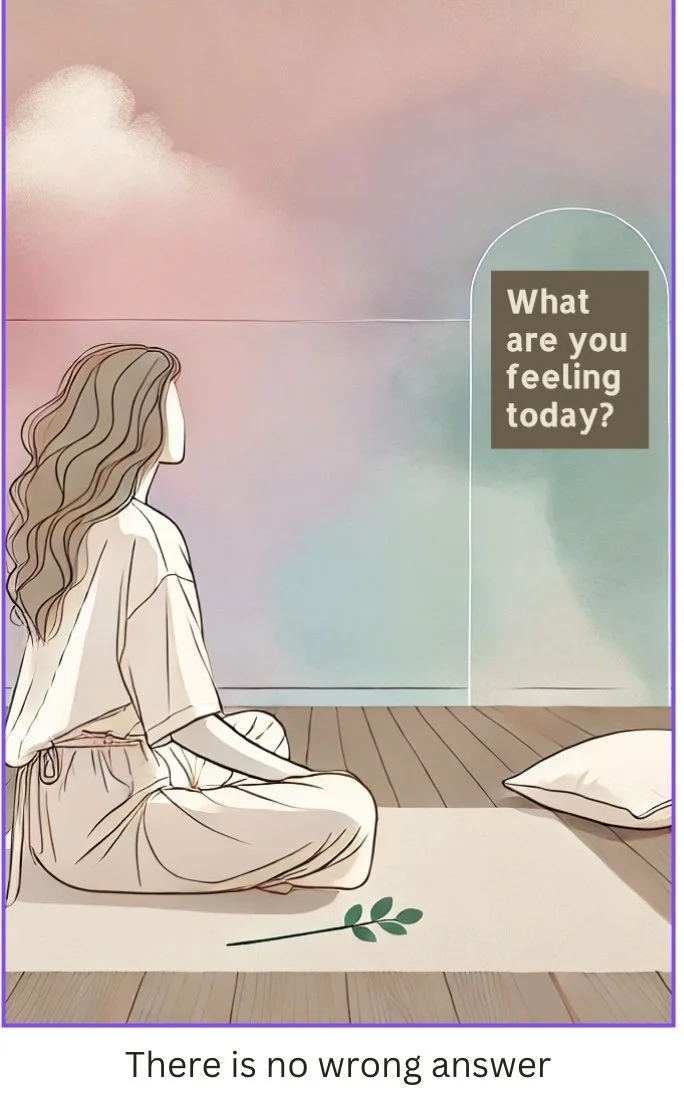
This is one of the first questions the book asks.
Not what should you be feeling.
Not what would be most reasonable.
Not what you believe the people around you would prefer.
What is actually happening?
At first, we may reach for familiar words.
Happy. Sad. Angry. Afraid.
They are good beginnings.
But our emotional lives contain far more detail than these few words suggest.
Sadness may include loneliness, disappointment, discouragement, or grief.
Anger may involve frustration, resentment, irritation, or the recognition that something important has been violated.
Fear may arrive as uneasiness, dread, apprehension, or alarm.
And joy is not always exuberant. Sometimes it is contentment, relief, gratitude, curiosity, or an almost imperceptible delight in being alive.
We can also recognize disgust and surprise, each with its own range of expressions.
There are different models for understanding and classifying emotions. These broad families are useful places to begin, not an exhaustive map of human experience.
What interests me is the difference a more particular word can make.
Consider someone who believes they are angry with a friend.
As they pay attention, they recognize that beneath their anger is disappointment.
And beneath that disappointment, perhaps, is the fear that the friendship matters more to them than it does to the other person.
Nothing about the situation has necessarily changed.
But something about their understanding has.
They may now be able to speak with greater honesty.
The right word does not solve every problem. Sometimes it simply reveals which conversation we actually need to have.
The Emotion and Sensation Wheel
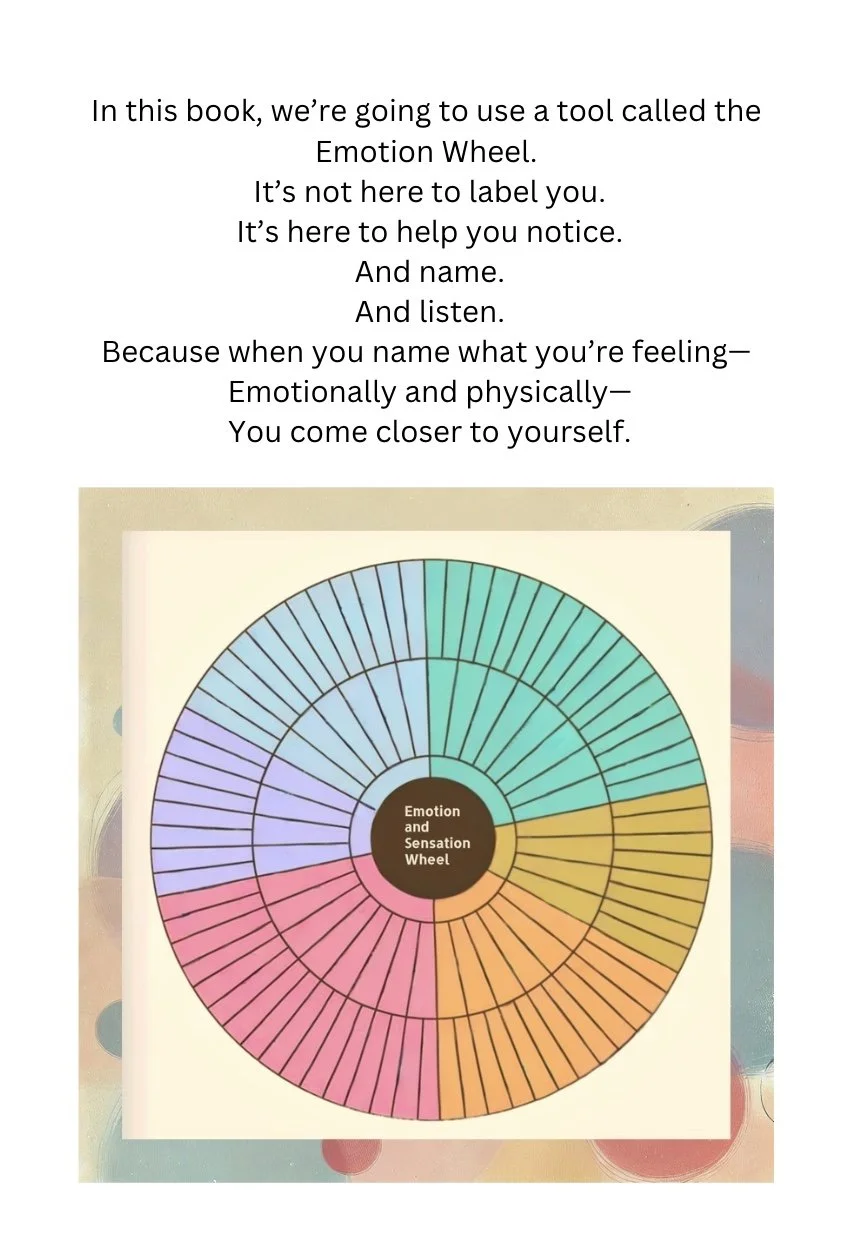
One of the central tools in Feel It. Name It. Come Back. is the Emotion and Sensation Wheel.
It offers a visual way to explore the language of feelings alongside the language of bodily experience.
Because identifying an emotion is only part of the story.
We might recognize fear, for example.
But how do we experience that fear physically?
A tightening in the chest?
A fluttering stomach?
Cold hands?
An urge to move?
And what about joy?
Does it feel light, warm, expansive, peaceful, energetic?
Sometimes it has a bodily quality that is difficult to describe. Sometimes we notice very little at all.
There is no universal physical signature for a particular emotion.
A sensation can have many causes, and its significance depends upon context.
This is where the language of somatic awareness becomes useful.
We begin learning words for what we notice.
Warm. Cool. Tight. Loose. Heavy. Light. Tingling. Fluttering. Aching. Numb. Relaxed.
These are descriptions, not diagnoses.
The ability to notice internal bodily signals is often called interoception. It is one part of the way we become aware of our physical condition and experiences.
Noticing these signals does not mean we must constantly interpret them.
It means that our bodies need not remain unfamiliar territory.
We can approach what we experience with curiosity rather than immediately trying to control it.
When the Body Has Something to Tell Us
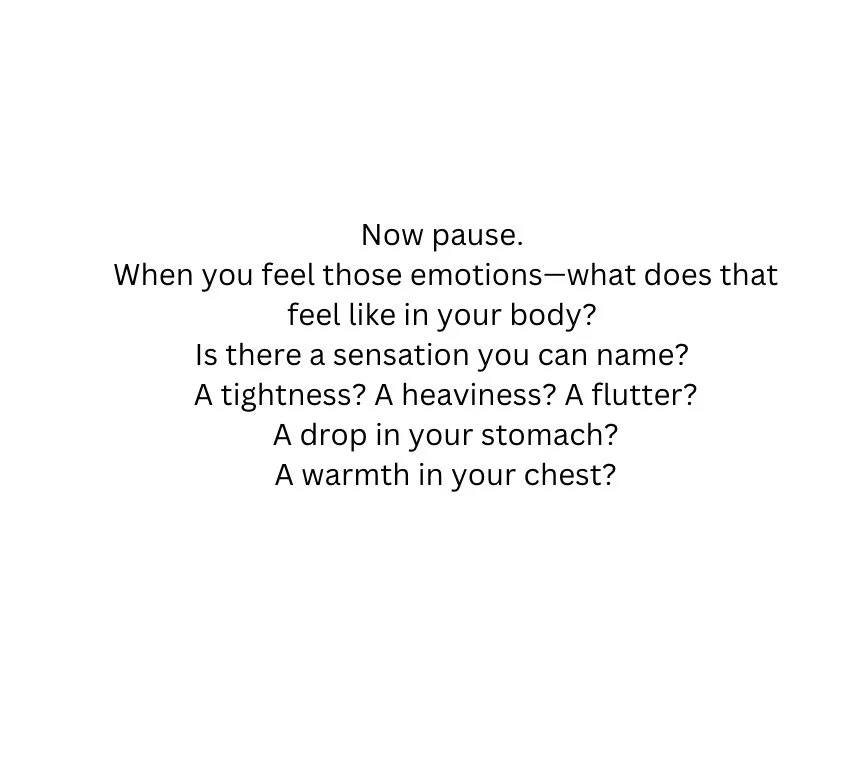
I find it remarkable how often people can recount the details of a difficult experience without recognizing what happened in their bodies while they were living it.
We remember what someone said.
We remember what we replied.
We remember whether we were right.
But we may not remember the moment our breathing changed, our shoulders tightened, or we felt an overwhelming desire to withdraw.
There is no need to become suspicious of every sensation.
And there is certainly no virtue in monitoring ourselves endlessly.
But sometimes a little awareness can help us recognize what is happening before we act.
We may discover that we are exhausted rather than angry.
That we are frightened rather than indifferent.
That we need a difficult conversation rather than another evening of quietly resenting someone.
Or that something lovely is happening, and we would like to stay with it long enough to enjoy it.
Emotional awareness is not merely about distress.
It is also about developing our capacity to recognize pleasure, affection, gratitude, curiosity, and delight.
If we want to inhabit our lives more fully, we must become willing to notice what is good as well as what is difficult.
Why This Work Matters in Different Places
I have used this book and the practices surrounding it with people in recovery, in correctional settings, and in contexts involving eating disorder recovery.
I have also brought this work into ordinary conversations with people learning to understand their emotional lives, relationships, and responses more clearly.
These settings are not interchangeable.
The needs of someone navigating substance use recovery are different from those of someone receiving eating disorder treatment. A correctional environment has its own realities, limitations, and responsibilities. Some people benefit from carefully supported body awareness practices, while others require adaptations or specialized professional care.
I would never suggest that one book or one practice is sufficient for every circumstance.
But I have seen how important it can be to begin developing language for internal experience.
How do I know when I am overwhelmed?
What happens in my body before I react?
What am I feeling beneath my anger?
What might I need that I have not been able to communicate?
And how can I begin responding rather than simply repeating a familiar pattern?
These are not questions reserved for therapeutic settings.
They belong to families, workplaces, friendships, communities, and the private conversations we have with ourselves.
We all live in bodies.
We all experience emotion.
And we all benefit from becoming more thoughtful about what we do with those experiences.
A Word About Emotions and Christian Faith
This particular reflection extends beyond the material presented in the book, but it belongs in the larger conversation I care deeply about.
Sometimes Christians have complicated relationships with emotions.
We may have been taught, explicitly or implicitly, that certain feelings reveal a lack of faith.
That fear means we have failed to trust God.
That anger is always sinful.
That sadness should give way quickly to gratitude.
Or that spiritual maturity means becoming increasingly unaffected by what happens to us.
But I find myself returning to the emotional life of Jesus.
Jesus wept at the tomb of Lazarus.
The Gospels tell us that He experienced compassion for the crowds.
Mark describes Him looking upon people with anger and grief at their hardness of heart.
In Gethsemane, Jesus spoke of His soul being overwhelmed with sorrow.
Luke also tells us that He rejoiced in the Holy Spirit.
We should not read every modern psychological category back into these passages or presume to explain everything about Jesus' inner experience.
But the Gospels do not portray the incarnate Son of God as emotionally absent.
He was fully human, without sin.
And His humanity was not an obstacle to His holiness.
This does not mean that every emotion we experience is an accurate account of reality, or that every impulse should be followed.
Anger can alert us to something important and still lead us toward an unwise response.
Fear can signal genuine danger or arise when we are not actually threatened.
Our feelings deserve attention, but they are not infallible guides to truth.
There is a difference between acknowledging an emotion and granting it authority over our actions.
Scripture calls us to wisdom, discernment, love, patience, and self-control.
Those virtues do not require us to pretend we are feeling something other than what we feel.
In fact, learning to recognize our emotions may help us respond more responsibly.
I believe the Christian life is meant to be lived within our actual humanity.
Not somewhere beyond it.
We bring our thoughts, memories, physical experiences, joys, fears, and questions into the presence of God.
And we allow Him to form us as whole people.
The goal is not to become less human in order to become more faithful.
It is to become increasingly available to God in the life we are actually living.
What You'll Find Inside the Book
Feel It. Name It. Come Back. offers visual explanations and practical opportunities to explore emotional awareness at your own pace.
Inside you will find:
An Emotion and Sensation Wheel for identifying and expanding emotional vocabulary.
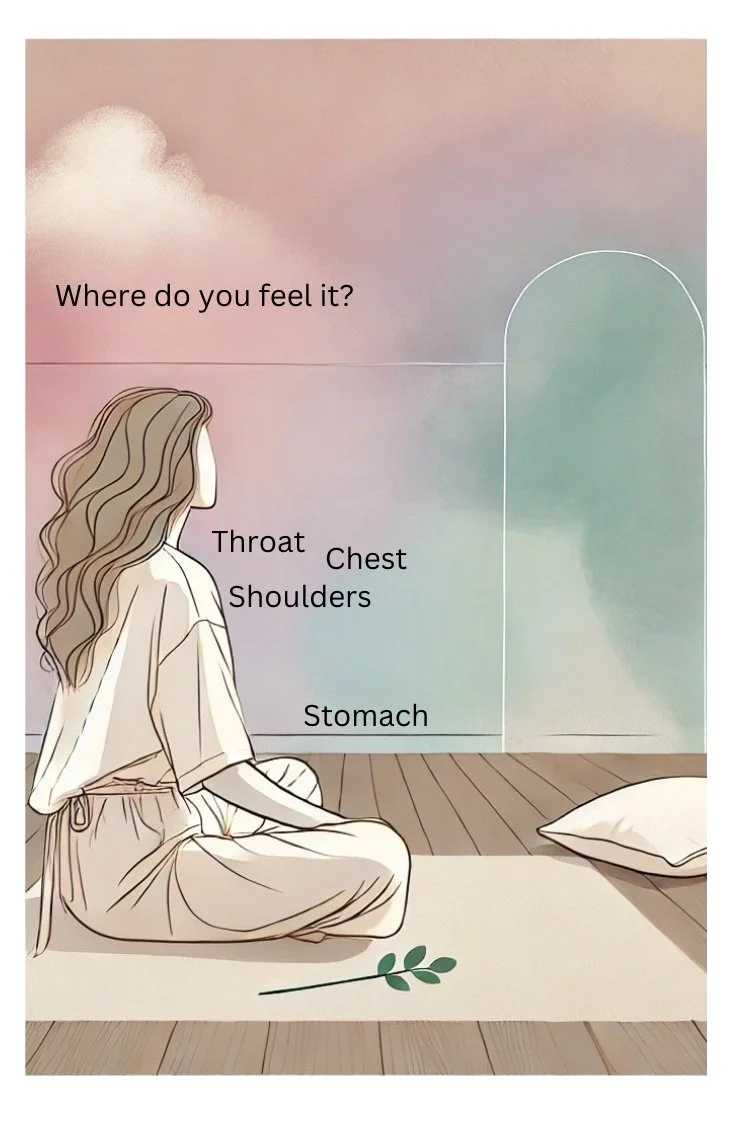
Illustrated invitations to notice where physical sensations appear in the body.
Word banks for describing emotions and sensations with greater precision.
Gentle grounding and somatic awareness exercises.
The 3-Space Practice, inviting reflection on head, heart, and body.
Journaling prompts for noticing patterns, experiences, and responses.
Labyrinth reflection pages and creative opportunities for processing recurring emotions.
Practices for considering the difference between automatic reactions and intentional responses.
You do not need to begin with a sophisticated understanding of psychology or somatic practice.
You do not need to know what you feel before opening the book.
That is part of why it exists.
An Invitation to Begin
Before continuing with your day, perhaps you would like to try something simple.
You do not need a quiet room, a particular posture, or a remarkable amount of time.
Begin with one question.
What am I feeling right now?
Choose a word that comes close.
Perhaps it is contentment.
Perhaps frustration, fatigue, anticipation, sadness, or gratitude.
If nothing seems quite right, you can simply begin with I am not sure.
Now consider:
Where, if anywhere, do I notice this in my body?
There may be something noticeable in your shoulders, chest, stomach, face, or hands.
Or there may not.
You are not trying to produce a sensation.
If focusing inward feels uncomfortable, you can keep your attention on the room around you instead.
Then ask:
What words might describe what I notice?
Heavy. Warm. Still. Restless. Tight. Open.
You may find one word.
You may find several.
Finally:
What might I need?
Perhaps rest.
Perhaps a conversation.
Perhaps a little movement or a moment outdoors.
Perhaps you are simply enjoying a good afternoon and would like to recognize it.
Nothing extraordinary needs to happen.
There is no test to pass.
You are practicing the ordinary, consequential work of becoming more acquainted with your own life.
Two Editions, One Invitation
Feel It. Name It. Come Back. is available in two paperback editions.
Black and White Edition | $15.95
A more affordable option for accessing the reflections, exercises, illustrations, and practical tools.
Full Color Edition | $35.25
For readers who would like to experience the illustrated material, including its watercolor designs and visual learning resources, in color.
Both editions offer the same core content.
Explore the Black and White Edition on Amazon
Explore the Full Color Edition on Amazon
Perhaps We Could Explore This Together
I am considering an online gathering for spring 2027 centered on Feel It. Name It. Come Back.
I would love to create a space where people can explore the Emotion and Sensation Wheel, expand their emotional vocabulary, experience gentle somatic practices, and consider how greater awareness might shape the ways they live and relate to others.
The gathering would be educational and reflective, not a substitute for therapy or specialized clinical treatment.
I am particularly interested in welcoming individuals as well as people working in recovery, Christian spiritual formation, and other community settings.
Details are still taking shape.
If this is something you would be interested in, I would welcome hearing from you.
Contact Me About the Spring 2027 Experience
Come Back to the Life That Is Here
I do not believe the purpose of emotional awareness is to become an expert in ourselves.
Neither do I believe that every feeling needs to be examined until we understand its origin.
There is a point at which noticing must become living.
We learn to recognize disappointment so that we can speak honestly rather than withdraw without explanation.
We notice fear so that we can consider what courage might require.
We become acquainted with anger so that we can respond to what matters without unnecessarily harming the people around us.
And we learn to recognize delight so that entire seasons of our lives do not pass while we are too distracted to enjoy them.
This is not about perfect emotional regulation.
It is about becoming less absent from our own lives.
About recognizing the experience we are having, giving it enough language to understand something of it, and choosing how we might respond.
We will not always get it right.
We will still misunderstand ourselves and one another.
We will still have days when the only honest word available is fine, and even that will be something of a guess.
But perhaps we will become a little more attentive.
A little more truthful.
A little more capable of bringing our whole humanity into the relationships, responsibilities, prayers, and ordinary moments that make up a life.
Feel it. Name it. Come back.
Not to the person you think you ought to be.
To the life that is already here.