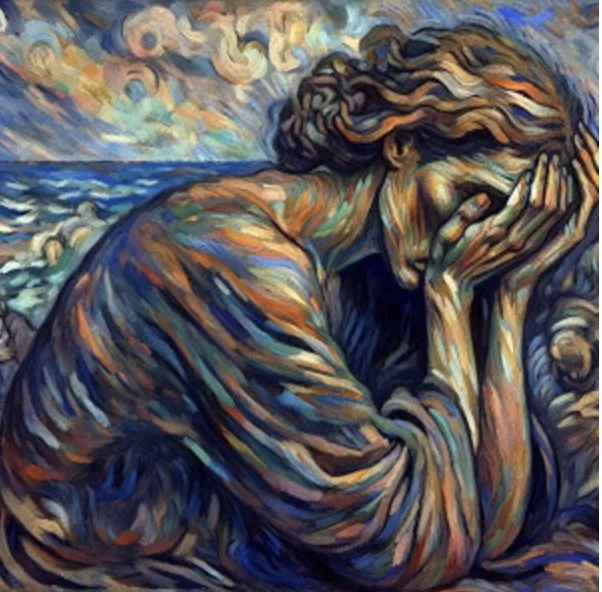
Expressive illustration of a grieving person with their head resting in their hands, surrounded by swirling blue, gold, and earthy tones. Artwork from Walking with Grief by Elle Mims Driscoll Miller.
An Illustrated Journey Through Loss, Reflection, and the Life That Continues
There are some things we do not get over.
We learn to live with their absence. We learn the peculiar geography of a life that continues after something essential has changed. We discover that grief can be quiet for weeks, even months, and then arrive in the middle of an entirely ordinary Tuesday.
A familiar voice in a recording. A particular time of year. A chair that no one sits in anymore.
Or perhaps there was no death at all.
Perhaps you are grieving a relationship, a diagnosis, a childhood, a family you hoped to have, or the future you once imagined.
There is a particular exhaustion in carrying something the rest of the world cannot see.
And sometimes words are not enough.
When Sorrow Needs More Than Words
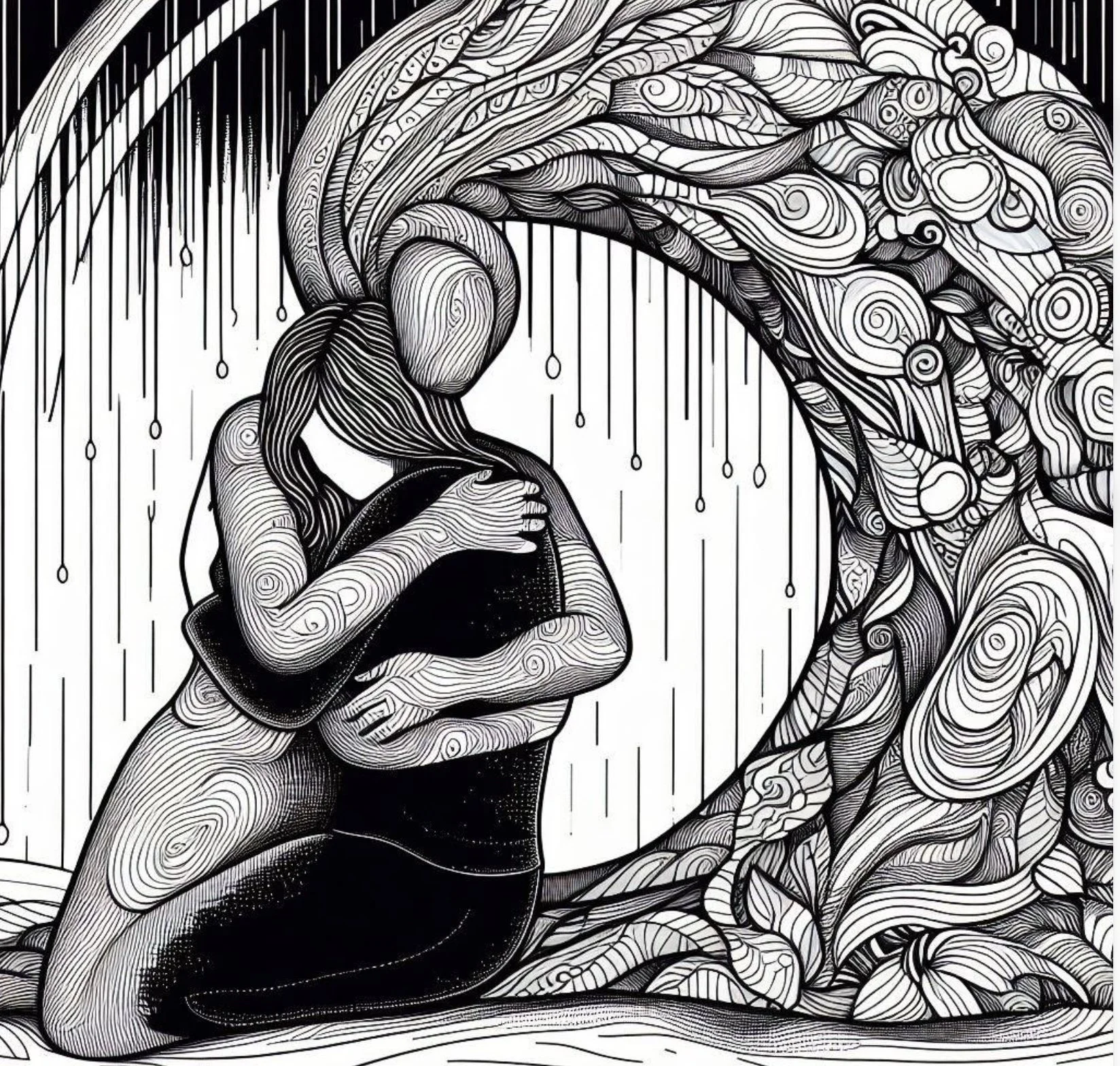
Walking with Grief is an illustrated book of contemplative reflections, creative coloring pages, journaling invitations, and gentle somatic practices for adults navigating grief and loss.
It was created with the understanding that grief is not simply something we think about.
We experience it in our bodies, our relationships, our memories, and the ways we move through ordinary days.
Sometimes we need language for what has happened.
Sometimes we need someone to sit beside us.
And sometimes we need to pick up a pencil, follow a line across a page, and give ourselves permission to be exactly where we are.
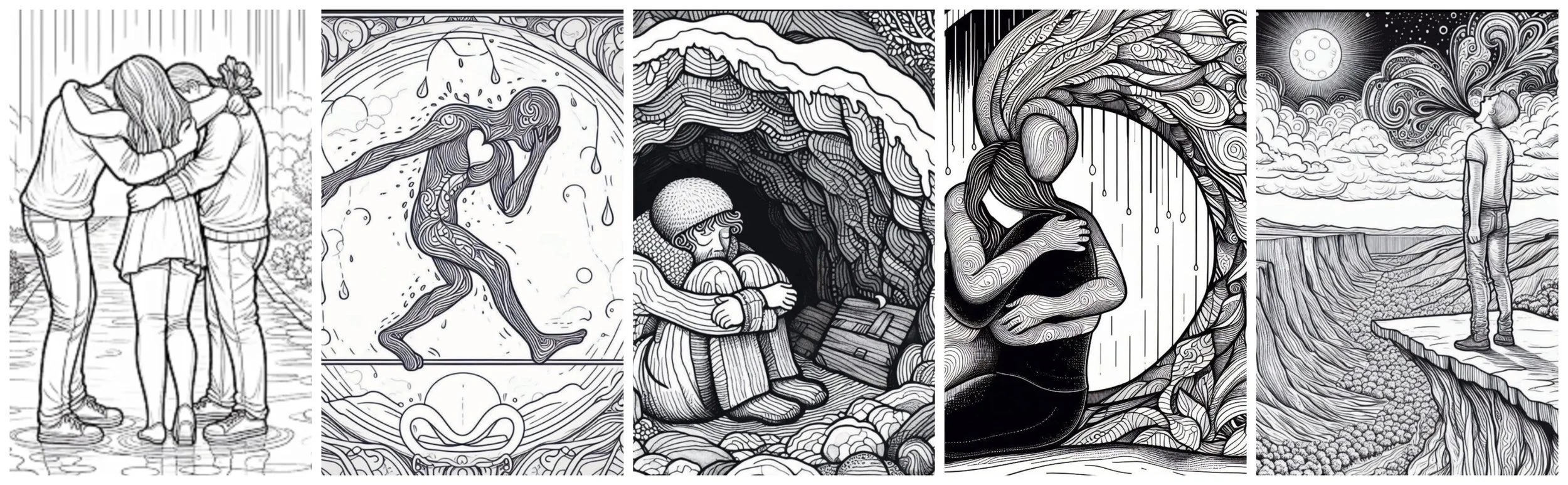
The illustrations in this book explore the many landscapes of sorrow. There are moments of companionship and isolation, the strange relationship between grief and time, the weight of exhaustion, the need to withdraw, and the unexpected tenderness of being held.
There is no correct order in which to experience these things.
And there is no deadline for becoming someone who no longer misses what has been lost.
What You'll Find Inside
Walking with Grief brings together several ways of engaging with sorrow:
Expressive illustrations and coloring pages that give visual form to difficult emotions.
Contemplative reflections that recognize the unpredictable, deeply personal nature of grief.
Journaling prompts for memories, questions, longing, anger, and the things we cannot easily explain.
Gentle somatic invitations for noticing how loss is experienced in the body.
Six thematic movements exploring companionship, emotional expression, withdrawal, the demands of everyday life, prayer, and remembrance.
You can move through the book slowly, return to particular images, or begin with whichever page seems to meet you where you are.
Nothing here requires artistic ability, the right words, or an explanation of why you feel what you feel.
Grief Has More Than One Face
There is grief that arrives with a funeral.
And there is grief that comes without ceremony.
The grief of someone who is still alive but no longer part of your life.
The grief of watching someone you love change through illness.
The grief of a body that no longer does what it once did.
The grief of infertility, miscarriage, estrangement, divorce, or a life interrupted by circumstances you never chose.
There is also the grief of things that never happened.
The conversations you thought you would have. The ordinary days you expected to share. The future you were quietly counting on.
Not all losses are recognized by the people around us.
But they are losses nonetheless.
And each deserves room to be acknowledged.
For the Questions Grief Brings
Why does grief return when I thought I was doing better?
Because grief is not a straight line.
Our memories are connected to places, sounds, relationships, routines, and expectations. Something as ordinary as a song or an anniversary can bring a loss into the present again.
The return of sorrow does not mean that everything you have learned or lived since the loss has disappeared.
It may simply mean that something important is being remembered.
What if I cannot explain what I am feeling?
You do not have to begin with an explanation.
You might begin by noticing a sensation in your body, choosing a color, drawing a shape, or writing a single word.
Sometimes emotional understanding develops gradually.
Creative reflection can offer a way to explore an experience without requiring us to organize it into a perfect narrative.
Can grief and joy exist in the same life?
Yes.
You may laugh over dinner and cry on the way home.
You may love the people who are present while missing someone who is not.
You may discover genuine beauty in a day that is also marked by sorrow.
Joy does not invalidate grief.
And grief does not mean that your capacity for joy has disappeared.
What if I am tired of people telling me to move on?
Perhaps what you need is not another instruction.
Perhaps you need companionship, room for remembrance, or the freedom to acknowledge that something still hurts.
There is a difference between making room for life to continue and pretending that what happened no longer matters.
You do not have to erase your love in order to keep living.
A Gentle Practice for Difficult Days
If you find yourself feeling overwhelmed, begin with something small.
Sit somewhere you feel reasonably comfortable.
Notice the surface supporting you.
Look around and find three things you can see.
Allow your attention to rest on something familiar.
If it feels helpful, open a page of Walking with Grief and choose a small part of an illustration to color.
You do not need to complete the page.
You do not need to feel better when you finish.
Simply notice what the experience is like.
What are you feeling? What do you need? Is there someone you would like beside you?
Sometimes the most important thing we can offer ourselves is the opportunity to respond to what is actually happening rather than what we think ought to be happening.
A Book That Walks Beside You
I did not create Walking with Grief because I believe every sorrow can be resolved.
I created it because I believe our sorrow deserves attention, language, companionship, and room to exist within the life we are still living.
There are days when grief demands to be heard.
There are days when it sends us into hiding.
There are days when it makes the simplest responsibilities feel almost impossible.
And there are days when we discover, unexpectedly, that something beautiful is still possible.
Not because the loss has ceased to matter.
But because our lives are large enough to hold more than one truth.
We do not honor what we have lost by refusing to inhabit what remains.
Sometimes continuing to live is itself an act of courage.
And sometimes that courage begins with something as small as opening a book.
Walking with Grief
An illustrated companion for adults navigating loss through coloring, contemplative reflection, journaling, and gentle somatic practices.
Explore Walking with Grief on Amazon
Other Companions for Grief and Emotional Reflection
Breathe Becomes Air
The Wild Edge of Sorrow
A 21-day devotional for death, estrangement, illness, life changes, and the grief that often goes unrecognized. Through honest reflections, gentle somatic and spiritual practices, and poetic blessings, this book offers companionship without demanding that you hurry toward healing.
When Christmas Isn't Merry
Embracing Healing Hues in Challenging Times
A reflective Christmas coloring book for those navigating grief, loneliness, loss, and complicated emotions during the holidays. Through intricate illustrations and thoughtful prompts, it offers a quieter place to spend time with whatever the season brings.
Explore When Christmas Isn't Merry
Feel It. Name It. Come Back.
A Visual Guide to Emotional Awareness and Somatic Healing Practices
A practical illustrated guide for understanding emotions, developing body awareness, and exploring gentle grounding and somatic practices.
Available in color and black-and-white editions.
Explore Feel It. Name It. Come Back.
Walking the Quiet Way
A Journal of Labyrinths, Reflections, and Sacred Return
Featuring more than 100 hand-drawn labyrinths, this contemplative journal offers space for grief, prayer, personal reflection, and the quieter work of finding your way through change.